


From "Everything Is Fine" to a Secure, Compliant IT Environment: What the Onboarding Audit Revealed
Author: Ivan Zvezdarski Sep 24, 2026
Helpdesk Bulgaria is your outsourced IT department: subscription computer and IT support for businesses in Sofia and across Bulgaria from €20 per computer per month. We support computers, laptops, users, servers, networks and backups, monitor systems 24/7, and the response time is 1 to 8 hours depending on the plan. Suitable for companies without an IT department and for companies with an in-house IT specialist who needs support.

Subscription computer support for businesses works as an outsourced IT department. Your employees have one place for every IT request, and we are responsible for the whole IT infrastructure, not just the individual problem. The service includes daily user support, maintenance of computers and laptops, servers, the network, printers, Microsoft 365 and cloud, backups, protection and 24/7 monitoring - with one subscription and one contact for everything. We resolve 95% of requests the same day, most of them via remote access, and when needed we provide on-site support. As a computer support company since 2005, we work only with businesses - from small offices to companies with several locations.
An in-house administrator is one person, with holidays, sick leave and limited expertise. An outsourced IT department is a team of IT specialists with monitoring, clear response times and know-how in servers, networks and security. A detailed comparison is in the blog article External IT department or in-house. Before choosing a provider, read What an SLA in IT support is and how to choose the right one and the IT Outsourcing Guide for Businesses. Practical tips are in How to reduce helpdesk tickets without risk to the business and 5 benefits of regular IT support for your office.
The service is designed for companies that want a stable IT environment, fewer interruptions, and a clear partner who is responsible for support.
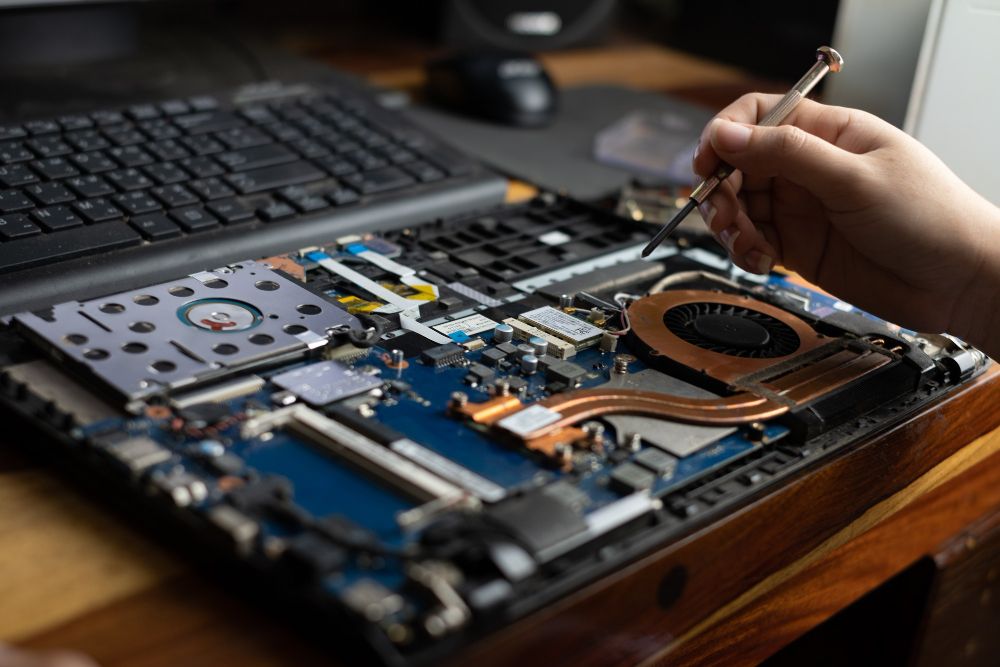
We keep your team's workstations in good technical condition through installations, configurations, updates, diagnostics and rapid troubleshooting. Through proactive monitoring, we monitor the status of devices and react before minor problems become a real risk to work. 24/7 monitoring is included in all plans. We also do regular preventive maintenance of the computers - checking their condition, disks and updates. When a problem cannot be solved through remote access, a computer technician comes to your office, depending on your plan.

We build and manage a backup strategy that protects your critical data and reduces the risk of information loss. We monitor backup tasks, test recovery, and prepare procedures for responding to a crash, human error, or ransomware incident.

We support your office network - LAN, Wi-Fi, VPN and remote access - and your servers as part of the subscription: we monitor them 24/7 and keep their updates and backups current. A server starts at €50 per month for a basic file server; for virtualization and complex systems, the price is set after a review. Details on the Server support page.

We support your employees' email and Microsoft 365: new users and licenses, access from the phone, shared folders and migration from another host. More on the Cloud services page.

Antivirus, updates and periodic vulnerability checks are in all plans. For companies with NIS2, ISO 27001 or GDPR requirements, we implement the technical measures. The documentation is prepared by our partner consultant, and you have a single point of contact.

We plan and execute controlled migrations to new hardware, virtual environments, or cloud infrastructure. The goal is minimal downtime, data protection, and a smooth transition without operational chaos.
We use a clear support process so your team receives quick help, proper prioritization, and transparent feedback.
Users can submit an issue by phone, email, or ticket. We make contacting support easy and convenient.
Each request is reviewed and prioritized according to urgency, impact, and business importance.
An IT specialist starts work remotely on your computer or at your office, depending on the problem and the fastest path to its solution.
We solve the specific problem and look for the root cause to reduce the likelihood of it recurring.
We track recurring issues, provide visibility, and recommend actionable improvements for performance, security, and stability.
If you recognize any of the following problems, it's probably time for more structured IT support.
Common problems with computers, laptops, printers or network devices
Delay in response when employees have a technical problem
Lack of a clear backup plan and uncertainty when restoring data
There is no one to monitor the status of servers, devices, and critical services
You rely on a random external technician instead of a permanent IT partner
You have an in-house IT person, but you lack additional expertise and capacity
Your IT person goes on holiday or leaves and there is no one to cover
You need to meet NIS2, ISO 27001 or GDPR requirements
Prices for subscription computer support start at EUR 20 per computer per month excl. VAT and go up to EUR 40 depending on response time and on-site visits. Servers start at EUR 50 per month.
20 €
per computer per month, excl. VAT
Suitable for small companies with limited budgets
30 €
per computer per month, excl. VAT
Suitable for small and medium-sized businesses working with a standard set of applications
40 €
per computer per month, excl. VAT
Suitable for medium and large companies with high IT standards and requirements using corporate applications
We have worked only with businesses since 2005 and we take responsibility for the result: 95% of requests are resolved the same day, with more than 350 tasks a week. We are rated 5.0 on Google.
Describe your needsOutsourced IT department for the price of a subscription: from €20 per computer per month, excl. VAT
A team, not one person: computers, servers, cloud and security
24/7 monitoring and response within 1 to 8 hours depending on the plan
Client portal with statistics on requests and hardware
An outsourced IT department is a team of IT specialists outside your company that takes care of your computers, servers, network, Microsoft 365 and security for a monthly subscription. Instead of an in-house system administrator, you get a team with 24/7 monitoring, a clear response time and support both remotely and on site in Sofia.
Subscription computer support is a monthly service in which an outsourced IT team takes care of a company's computers, users, servers and network for a fixed price per computer. Instead of paying by the hour for every problem, you get 24/7 monitoring, a clear response time and one contact for all IT requests. With us it starts at €20 per computer per month excl. VAT.
Yes. Remote support (monitoring, phone help and remote access) covers all of Bulgaria. We visit clients on site in Sofia, and outside Sofia by arrangement for an extra travel fee. We work with businesses only.
In practice, we pick up most requests almost immediately and resolve 95% of them the same day. We guarantee a maximum response time by plan: within 8 hours on Remote, within 2 hours on Standard and within 1 hour on Professional.
Yes. We work with businesses from one computer upwards. For a small office without a server, the Remote plan from EUR 20 per computer per month is usually enough, and if you need on-site visits, the Standard plan.
Yes. On the Standard and Professional plans we set up and test backups, so after a crash we restore files, systems and services from the last tested copy. If a disk is damaged but still readable, we recover the data ourselves; when it is no longer detected, we work with a specialized partner.
We start with a conversation about your needs. We review your environment - computers, servers, network, backups and access - before proposing a solution. Then we propose a plan and a price, and at handover we document the environment, switch on monitoring, take over access and make the first improvements.
Yes. We prepare the transition so that work does not stop: we take over access, documentation and backups and switch on monitoring. More in the blog article Changing IT provider without downtime.
The service covers support for users, computers, laptops, peripherals, operating systems, business software, backup, servers, networks and a helpdesk process for managing incidents and requests.
Yes. We become your outsourced IT department: we support companies with 1 to 150 computers that have no in-house IT team or do not want to depend on one person.
Yes. We support internal IT teams with extra capacity, specialized expertise and help with infrastructure, cloud and security. We take over part of the tasks and cover for your IT person during holidays or sick leave.
Prices are per computer per month, excl. VAT. Remote: €20, up to 10 computers, response within 8 hours, no on-site visits. Standard: €30, response within 2 hours, up to 2 on-site visits per month in Sofia. Professional: €40, response within 1 hour, unlimited on-site visits, EDR and SIEM included. All plans: unlimited remote administration 10:00-19:00, 24/7 monitoring, antivirus, periodic vulnerability scans and a client portal. Server support: from €50 per month for a basic file server. A volume discount can be discussed on enquiry, after a review and analysis of your needs.
Example excl. VAT: Remote plan 10 x €20 + €50 for the server = €250 per month. Standard plan 10 x €30 + €50 = €350 per month, with response within 2 hours and up to 2 on-site visits per month. Let's talk about your needs and we will propose the best solution and price.
We mainly work on a monthly subscription; one-off help is accepted as an exception, after a conversation.
Statistics of your requests, invoices and an inventory of your equipment. Requests come in by phone, email and the portal, each with an owner and a status until it is closed.
A team. Every request is logged and taken by the first available engineer, so one person's absence never stops your work. In practice we pick up requests almost immediately; we guarantee a maximum response time per plan.
Briefly describe your environment (number of users, offices, servers) and we will propose an appropriate plan and priorities.